Dementia: ‘The New Reality’

I have mentioned before the words of a Consultant at the Memory Clinic following Maureen’s diagnosis: ‘You will have to get used to the new reality.’  At the time I hadn’t got a clue what he was talking about.  Eighteen months down the road and Maureen’s reality can be grasped from her words below:Featured image

  • ‘Other people keep moving my things from where I have left them.’
  • ‘Why do people have children if they can’t afford to buy them clothes.  Haven’t my parents got any money?’.
  • ‘Where is my mum?  Why doesn’t she come to see me?’
  • ‘Why don’t my children come to see me?  Don’t they know where we live?’
  • ‘Have any of my family ever been here to this house?’
  • ‘How do I know we are married?  Where is the Marriage Certificate and wedding photos?’
  • ‘Please tell me where we met?’
  • ‘Where are the other people who own this house?’
  • ‘Do the children know where we are going today?’
  • ‘Are you going to work today?’
  • ‘What day, time, month or year is it?’

The above list is only a snapshot of the new reality.

The Counsellor at our Medical Practice puts it in a nutshell.

Dementia means having no concept of PLACE, PERSON or TIME.

Dementia: Becoming A Better Care Partner

As a Care Partner it is easy to look around and point the finger at what others could be doing a little better.  That is simple and anyone can do that all day long.   What is a little more challenging is to look at your performance as a Care Partner and see if you can sharpen up your act.  This is not a Sunday confession session, it is an attempt to list a few things that might just make our journey with dementia a little easier for us both.

The point of departure is an acceptance that Maureen’s dementia is progressing .  Confusion, distress and fear are now predominamt in her presentation.  What follows is a list of things I can do to help us as we travel this road:

  • To attempt to understand Maureen’s reality
  • To attempt to help others to understand Maureen’s reality
  • To listen rather than talk
  • To use simple language and short sentences
  • To stick to one subject at a time
  • To be visible as much as possible
  • To keep the house tidy
  • To have set places for things
  • To pare down Maureen’s clothes even further
  • To attempt to keep Maureen in a positive state of mind
  • To find meaningful activities
  • To socialise in appropriate circles
  • To accept that Maureen’s world is shrinking
  • To try to secure an appropriate Care Package
  • To continue to utilise skills and knowledge within relevant reference groups

I am hoping to blog later in the day on Maureen’s reality.  It depends on how the day progresses.

Dementia: Superb Support from G P

stock photo of medical doctors - elderly patient is being observed by doctor - JPG

Yesterday, once again,  Maureen received superb support from her G P.  I phoned up to register that she had a very sore and ulcerated mouth. The GP phoned back within minutes and advised us to go to the surgery as soon as possible.  Within minutes of our arrival we were called in to his consultation room.

The G P gave Maureen a very thorough examination and prescribed some ointment, to use alongside the pain killing gel she had been applying for the last few days.  He also chatted to her about how things were going and took he blood pressure.  He is a lovely man and always looks after Maureen as if she was his own daughter.

When Maureen arrived home she was in tears feeling that once again her health was creating problems.  She was also confused about her prescription.  The pharmacist had explained that the ointment needed to be applied five times a day.  Unfortunately, she had no idea that Maureen has dementia and her explanation had created real confusion.

Later in the evening upset emerged once again with Maureen expressing that: ‘she didn’t know what to do.’  It took me a few minutes to realise she was talking about the application of the ointment and reassured her that I would help.   Once the first application got underway she settled and accepted more ointment on retiring.

Maureen seems in realtively good spirits this morning.  She keeps commenting on her thoughtful G P and her praise of  is fully justified.  We recognise how well the Practice is managed with it’s innovative approach to solving the shortage of G P’s in the area.

The approach to dementia in this country would benefit from a fundamental review in many areas.  However, we are fortunate that our G P Practice is so supportive at a time when they struggle to recruit medical staff.

Dementia: Mission Impossible?

I am beginning to wonder if social services are on ‘Mission Impossible’ trying to deal with dementia.  Members of staff are expected to make an assessment of Maureen’s condition by occasional visits for short periods of time.  They then make decisions about thFeatured imagee amount, and type, of care needed. The photograph of the hole in my neighbour’s garage will help me to illustrate the point I am trying to make.
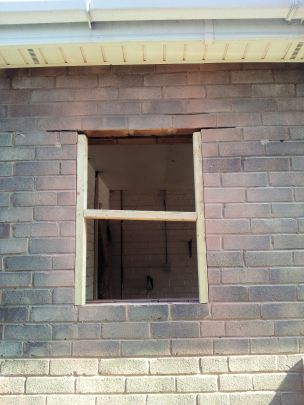
Our social worker chatted to Maureen for a couple of hours on Wednesday morning.   Maureen seemed in good form and relatively lucid for the duration of her visit.  The social worker concluded that Maureen has capacity to determine her care needs when I plan to be out-of-town visiting family.   She accepted  Maureen’s assertion that she is safe to be left to her own devices for considerable periods of time.

Myself and Maureen’s main carer disagree with the social worker’s opinion.  We have seen how easily Maureen’s presentation fluctuates and confusion, and distress, become dominant in her presentation.  This is where the picture on the right comes in.

A short time after the social worker had gone Maureen became very concerned that next door’s builder would soon be knocking holes in our house .  She went out to talk to him to share her concerns.  Fortunately, he was aware Maureen’s dementia and he handled her concerns sensitively.  His father had  dementia some years ago and he is well versed in the confusion that is prevalent at any time of the day.

The social worker hasn’t got a chance to make an informed judgement by chatting to Maureen on the sofa.  I’m sure she knows that presentation varies but she has never seen Maureen when she is ‘acting out of character’.  The list below gives a few examples of familiar incidents from Maureen in action:

  • Not knowing who familiar faces are: including myself and Chloe.
  • Believing she is living in a Care Home.
  • Thinking her immediate family don’t know where she is.
  • Trying to boil the kettle with the lid off.
  • Being unable to switch on the TV or use the remote control to change channels.
  • Failing to understand how to adjust the central heating.
  • Wandering away from home and leaving external doors wide open.
  • Misplacing keys to external doors.
  • Struggling to find her way home.
  • Stumbling into things, as her eye sight is so poor.
  • Thinking I have gone out when I am in another room.
  • Forgetting that the social worker has visited.
  • Having no recollection of important discussions that have taken place in the previous half hour.

The social worker is being placed in an invidious position and given an impossible task.  Maureen remains a highly intelligent woman who can still ‘talk a good game.’  She is unaware of her ‘out of character behaviour’ and the social worker has never seen her in action.

It also appears that there may be practical, and cultural,  issues within the social workers organisation.  It has not been possible to get through to her dedicated mobile for the last couple of weeks.   Her number has been unavailable.  There have also been several examples of E Mails not being acknowledged, let alone progressed . It is also possible that her workload makes it difficult to keep to deadlines or arrange meetings.

If those with dementia and their Care Partners are to remain safe, and sane, we need to call time on Mission Impossible. On Wednesday next doors builder gained a much clearer idea of how Maureen was than the social worker.  He had two distinct advantages:  he saw Maureen in action and probably more importantly; he had experienced dementia within his own family.  He knows, from bitter experience, it would be risky to rely on chatting on the sofa for a couple of hours before judging whether Maureen is safe to be left to her own devices.

NB: There will be a further blog today sharing a really positive experience.

Dementia: ‘Strictly No Thanks’

Image result for strictly come dancing floor graphics

Maureen and I have always been fond of ballroom dancing.  I often take her in hold at home and we strut our stuff in the kitchen or lounge.  We are a little out of step following Maureen’s stroke and my bilateral hip replacements.  Some years ago we got to Gold Medal standard with Latin and Ballroom.  We are always taking about rejoining a group of friends we used to go dancing with at a local studio.  Whenever we bump into one couple we always say: ‘we’ll be back’.  I genuinely believe it won’t be long until we are back on the floor and I may just have the courage to lead my Dancing Queen.

A couple of days ago when taking to a colleague from the Memory Service dancing came up in our discussion.  I contact Kelly occasionally, as I do a small amount of voluntary work for Dementia Engagement.  She asked me when we would be along to the Tuesday afternoon Dance Session that she has organised?  I had to tell her that she would never see us on the floor at her sessions.  The reason being quite simple: Maureen doesn’t want to go to activities dedicated to those who have ‘memory issues’ – mustn’t use the term ‘dementia’ you see with the Memory Service!

When I mentioned Kelly’s initiative to Maureen she said: ‘You are not taking me along to make an example of me’.   I had suggested that  we might help Kelly out by taking some organisational responsibilty for Tuesday afternoons.  Maureen made it plain that she would sooner stay at home, alone, and let me do my ‘voluntary bit’.  Within minutes I saw her point.

We will go dancing again; perhaps later today.   I’m sure I only have to put the right music on and we’ll be off somewhere in the house.  When we venture out to blow off the cobwebs at a dance studio, or hall, it will be along with familiar faces.  Attending events put on by the Memory Service, or other well meaning organistaions is, not for us.  We both still have the capacity to choose how we want to spend our lives – we don’t need others organising things for us.

By the way the photograph is of Kevin (from Grimsby) and his partner.  His dad Keith taught us the slow foxtrot a few years ago.  I don’t think we would get a ‘Ten from any of Them’.  However, it would be our version of the dance at a venue of our choice!

Dementia: Taking Control

One area in which I can take control is the home environment.  Maureen often thinks she is either in her Aunties house or  a Care Home as she doesn’t think she lives here.  That doesn’t really matter.  What I have to do is to make our home more dementia friendly to make life easier for both of us.  Sorting out Maureen’s clothes so she is not overwhelmed by choice can only help.

Yesterday afternoon was a very distressing experience for me.  Maureen has loads of clothes and turns out every day in her blue joggers and a choice of a few of T Shirts.  There are also couple of cardigans she wears and that is about it.   So while she had a late afternoon doze yesterday I pared down her wardrobe a little further.  There are now two further bags of clothes for the charity shop.  The whole process was upsetting, as most of the items brought back happy memories of times and places.

I just had to do something practical yesterday to try to move things forward.  Even more inertia from social services yesterday suggesting a visit but not able to confirm.  I just wonder what it will take for them to move on the need for more support here and a Carers’ Assessment .  I wonder if they wait until Care Partners collapse in a heap before they move themselves?

One real positive from yesterday.  Our new kid on the block, Rosie, shone once gain.  Her and Maureen have really hit it off and my task is clear: to nab her for some weekend sits when she starts University in a couple of weeks.  All of this would be easier if social services would let go of the reigns and let me take control.  I do not understand what their procrastination is all about.  I am beginning to wonder if there are systemic problems that mean they simply lack the capacity to give a worn out old Care Partner the support he desperately needs.

Dementia: It’s Time to Take Control

I had a good chat with one of Maureen’s sons yesterday.  He made a salient point that could ease things here on several fronts.  His suggestion is to take control of things a little more on the care front.  It is possible that social services are so snowed under that they lack the capacity to provide the support we now need.

I must admit I have stayed away from having a Personal Buget and utilising Direct Payment.  I think I have got the wording right but possibly the new Care Act uses different terminology.  In short, all this means is that  we become quasi employers and hold our own budget to buy in the care we need.  It sounds even more work but if we have greater control over things it may be a sensible investment of time.

My plans to be a little more organised have already paid dividends.  Yesterday got off to a really good start with no tears, or difficulties, about finding suitable clothing.  I put out a small selection of clothing and Maureen decided what to wear without any difficulty.

Maureen also did exceptionally well yesterday completing lots of household tasks with minimal prompting. .  The only problem is stopping the woman once she is in full flow..   She just won’t let up when she can see something that needs doing.  My fear on such days is that she wears herself out so much that distress and confusion follow.

In fact I think the confusion that emerged early evening may have been the result of over exertion.  After a late evening stroll we returned home and started watching television.  We watched the Battle of Britain Anniversary celebrations for a while and Maureen seemed uncomfortable.  She kept turning to look at me; as if she was uncertain who I was.  When we began our bed time routine she was intially reluctant to share a bed with me.  She put forward a number of reasons why she should have a bed to herself, until eventually suggesting there was room for both of us in the marital bed.  The night passed peacefully apart from another early to bed early to rise routine for me.  Hence this rather early post

Rosie our new recruit will be here in four hours and it will be interesting to see how they get on together today.  After last week’s promising start I am optimistic that things will go well.  I will leave then to it and allow them to sort things out together.   As I am often advised by colleagues on Talking Point it is a time to ‘go with the flow’ and let their relationship develop..

Dementia: Case Conference Needed

The need for more ‘hands on deck’ here grows on a daily basis.  This isn’t just a tired Care Partner speaking: anyone who is in regular contact with Maureen sees how much her presentation is changing.  Chloe, our regular carer, has to answer the same round of questions whenever she sits with Maureen for a couple of hours.  ‘When are you going on holiday; have you got a car’; to mention just two of the regular queries.

Featured image

Two hours after Chloe had left yesterday afternoon Maureen asked me ‘if she was coming today?’  She clearly had no recollection of three hours she had spent with Chloe earlier in the day.

During the afternoon I followed Maureen on one of her walkabouts.  Keeping a short distance behind I observed her antics at close hand.  It soon became clear that she is struggling with her sense of direction; wandering down dead ends and drives to other peoples’ properties. As we approached the Drive we live in she declined to follow me as I returned home with some necessary urgency.  Following much needed relief It took me half an hour to  track her down as she wandered away from our house in the direction of Cleethorpes.

It is unfortunate that our social worker was unable to keep her appointment wtih us yesterday afternoon.  This is causing further delays in the urgent need to review Maureen’s care needs.  My work load is now impossible: keeping Maureen safe; trying to lift her mood and carry out domestic duties on a 24/7 basis is too taxing.  There is now a significant risk of carer burn out and more help is urgently needed.

I am also no further forward with my plans to visit family in Coventry and London.  It is one thing to try to become more dementia friendly, and I am doing my best on that front.  Just a glimmer of hope on a bit of ‘me time’ even significant respite would just hit the right spot at the moment.

The next thrust in my Action Plan has to be getting a Case Conference underway to obtain the level of support that is now needed here.  My Admiral Nurse keeps asking me what she can do to help and I have told her straight: ‘convene a Case Conference for 11.30 on Friday’.

Becoming More Dementia Friendly

I have taken out a paragraph from the post I reblogged from George Rook yesterday to open today’s blog:

People with dementia, and remember it can happen young, are generally left to their own devices. They lose jobs. They meditate on their forthcoming decline. They become depressed. They lose social contact and community interaction. They may descend into living with misery.

His hard hitting analysis of the way dementia is treated in this country hits the nail on the head  from what I have seen and we have experienced. During the coming week I will use George’s analysis to help me formulate my Action Plan for the next few months.  What follows is my starting point: becoming more dementia friendly.

I can make life easier for Maureen in all sorts of ways.  I need to acknowledge that her brain has been damaged by stroke and the dementia that has followed is a progressive condition.  What I need become is Maureen’s back up brain    (BUB,Swaffer).  That also means I have to make some fundamental changes in my approach to daily living: something of a  role reversal in our household.

One of Maureen’s mantras used to be: ‘everything has its place and everything in its place’.   In the early days of our relationship I must have driven her mad with my chaotic approach to life: with little having its place.  I now have to develop a very tidy and systematic approach to life.

I also have to keep reminding myself that Maureen needs to be prompted on many aspects of daily living.  If I leave her to her own devices, she can forget what she is doing or get completely lost in a task.  Yesterday morning she put newly washed clothing on the line alongside items that were waiting their turn to go in the washing machine. The other evening she got completely mixed up when she was trying to tidy up the mess I had left in the kitchen.  Last night while I was watching televison in the lounge I found her in floods of tears ‘wondering how she got had here’.  This morning she is crying thatshe: ‘wants to go home to be with her family’.  Therefore, I need to keep to the forefront of my mind that her short term memory might let her down at any time and  lead to confusion and distress.

So the first stage of my Action Plan is to become more dementia friendly myself.   I need to be more organised and take account of the progression of Maureen’s dementia and up my game accordingly.

Dementia is not cancer

I find George’s blog very thought provoking. He articulates my own thoughts on how dementia is treated in this country. The challenge for me is how to help Maureen and I to have a life with dementia in this climate. I will address that issue in Monday’s blog. My method will be quite simple; to develop an Action Plan as a Care Partner.

georgerook51's avatargeorge rook

People with an early, timely diagnosis of dementia have time to make the best of their lives. They can plan finances, power of attorney, a care and living plan…

image

Then what?

There is still precious little support provided across the country post diagnosis, until crisis.

Many providers and councils say they provide care co-ordinators for all people with a diagnosis of dementia. But we know they usually don’t. (Initial findings of a survey by ADASS in the West Midlands). There are a few proud exemplars, far between.

There are excellent peer groups scattered across most areas but few people with dementia get to them.

People with dementia, and remember it can happen young, are generally left to their own devices. They lose jobs. They meditate on their forthcoming decline. They become depressed. They lose social contact and community interaction. They may descend into living with misery.

image

Yes, we talk about…

View original post 136 more words