Tag Archives: Better Practise

Dementia: ‘I Feel Like A Prisoner’

I am posting earlier this morning as I will be leaving for London in an hour.

It is a sobering experience listening to your wife telling you that: ‘she feels like a prisoner in her own home’.  Yesterday morning Maureen was at pains to explain to me how she felt: ‘locked in and no longer able to come and go as she pleased’. I fully accept her feelings on this matter and am trying to address her concerns in a number of ways.vector illustration of a female convict behind bars....... bars are contained in clipping mask - stock vector

My intial response has been to explain the caution that has been applied to her recovery from stroke.  How we have all been very concerned to minimise risks, as she moved from feeling her way around, to finding her way around.  I also admitted that my anxious behavior had not always helped: panicking and calling the police on a couple of occasions has been a little over the top. Later in the day I tried another approach to attempt to help ‘the prisoner relinquish her bonds’.

Have to break off from posting this blog as I can hear shouts from upstairs.  Thankfully all is well but Maureen has been dreaming that she is being chased by an Alsatian.  I may not have mentioned before that she is frightened of dogs, as she remembers one attacking her mum when she was a small child.  So back to the prisoner issue ……

As the sun was shining yesterday afternoon I suggested that Maureen might go out for a while by herself.  I said I would leave her to go off for a while by herself.  I reassured her that if I thought she had been gone for too long I would come and find her.  For whatever reason she decided that she didn’t want to go out at that particular time.

I know that some of my colleagues on Talking Point will shake their heads at my approach to Maureen’s concerns.  I can fully understand their response to what might be seen as a reckless approach to Maureen’s welfare.  However , I would contend that my proposal is the next logical step in Maureen’s recovery from stroke.  She clearly needs to see that ‘my money is where my mouth is’.  I cannot keep saying: ‘she is making an incredible recovery from stroke’ and keep the chains in place.  Every day, and in every way, I have to keep repeating my message that she is not ill she is recovering from stroke.  Prescribed Disengagement will never be the way forward in this household.

Dementia: An Amazing Conversation

In the time we have been together Maureen and I have many illuminating conversations where she has shared her intellect and compassion.   We were talking for a considerable period of time very early this morning and I could only describe our conversation as AMAZING.The Brain's Way of Healing : Remarkable Recoveries and Discoveries from the Frontiers of Neuroplasticity - Norman Doidge

The amazing thing was that Maureen demonstrated her intellect remains intact and she is beginning to use it to correct her faltering memory.   She is also beginning to understand that her brain is continuing to recover from stroke.

One of the most exciting points of her converstaion was when she corrected an element of her confusion.  She began to talk to me about ‘her husband Paul’ and then she laughed and corrected herself and said: ‘I mean you of course’.  I have heard her correct herself in retrospect before but never in the same breath.  The other thing that I found really exciting is her grasp of how tiredness means that she is sometimes not a full shilling.  We nearly fell out of bed laughing that when she is tired she is only ten old pennies.

Am I getting carried away: is all of this hopeful optimism trying to prove the pundits wrong?  The simple answer to that is I don’t think so and it is better to wake up with a smile on my face than a frown.    It is time for a detailed look at how the brain can heal itself and I hope to be reading what Norman Doidge has to say as soon as possible.

Dementia: The ‘Gale Force’ Approach to Caring

Yesterday I posted a suggested Code of Conduct for guiding our approach to Maureen.  Later in the day I realised there was something else that we needed to sign up to.  We need to ensure that our communication with Maureen is always  supportive to her reality.

As I watched our carer  in action yesterday I saw what was needed to go alongside a Code of Conduct.   All Gale’s communication with Maureen was compassionate and reflected her reality.  I could not fault her performance and I have shared aspects of it below.  I have tried to summarise the priciples behind how Gale interacts with Maureen as something that we all need to sign up to.

Maureen was still sorting her underwear out when Gale arrived, so I managed to update her on recent developments.  I then suggested that she popped upstairs to see if Maureen needed any help.  She asked Maureen if she  wanted anything adding to the shopping list that I had drawn up.  Maureen said she was quite happy to leave things to me, and sent Gale on her way to Lidl.

Gale returned with our food shop as I was about to leave for a hospital appointment.  As I was on the door step I heard her ask Maureen if she wanted to help her unpack the purchases.  Then she played her trump card by saying: ‘Shall I pop off after we have unpacked or shall we have a cup of coffee and a natter?’ Maureen happily accepted the latter.

When I returned from my physio appointment they were still chatting together in the lounge.  With the banter that came my way I knew that Gale had worked well – yet again.  She has the remarkable ability to work out what Maureen wants on the day and then respond appropriately.

After Gale had gone Maureen said how much she had enjoyed chatting to Gale.  When you think about how Gale approaches her work it is not surprising that Maureen enjoys her company.  We all need to do it the ‘Gale way’ and sign up to the following:

  • Focus on listening not talking
  • Give Maureen lots of space to do her own thing
  • Never give Maureen any bad news or negative information
  • Never contradict Maureen’s reality:  particularly over time or day
  • Let Maureen take the rest she feels she needs
  • See Maureen as a person: not someone with dementia
  • Follow the principles of’ ‘Compassionate Communication‘: including telling ‘Love Lies‘


Dementia: A Code of Conduct

It is going to take Sue our social worker a while to review our Care Plan.  In the mean we all learn to sing from the same ‘hymn sheet’ and this Article from the latest edition of Alz Live is a helpful starting point.  I am therefore going to circulate this extract to family, friends and carers an interim Code of Conduct that we all need to sign up to:

‘Making the Most of Your Visit

by TARA HEATH

Not being known by someone who is the centre of your world.

Not being able to recognize the person you once idolized; seeing a completely new and strange person replace someone who was once so familiar to you – coping with the changes that the effects of Alzheimer’s can have on a loved one can be quite challenging.

Not only is it hard to accept the changes that you see happening before your very eyes, it is hard to understand how to deal with those changes. However, accept and understand you must, because at the end of the day, that person is still your grandparent, your parent, a dear friend, or someone else who you hold near and dear to your heart.

Part of the battle of successfully coping is understanding what to expect. You want to make the most of your time with this person, but feeling overwhelmed and unable to process the changed person that you see before you is natural.

In order to make the most of your visit with a loved one with Alzheimer’s, prepare yourself so that you can enjoy your time together as much as possible.

Be Knowledgeable

You have the image of your jovial grandfather in mind, but upon visiting him, you are startled to find how much he has changed. In order to avoid feeling overwhelmed, be knowledgeable about the changes that you will likely experience. He or she may not know who you are, may become easily upset, or may think you are someone else. Knowing to expect this type of experience can allow you to respond in a positive way, ensuring your visit is a successful one.

Offer a Greeting

If your mother has Alzheimer’s, you know that her not knowing or recognizing you is not abnormal. By offering a warm greeting and introducing yourself, you offer her the chance to place who you are and set the stage for a successful meeting. Those with Alzheimer’s tend to crave physical touch, so offer a warm hug or hold their hand as you sit together.

Be Courteous

Though your loved one may be forgetful and may even act childish in some ways, always treat him with respect. Never belittle or talk down to him. He is a person who has lived a full life and is battling a very difficult disease. Show your respect and be courteous – although they may not be able to show their appreciation, it’s very important.

Don’t Overwhelm

Sharing too much at one time with your loved one is often overwhelming for them. Pick and choose what you want to say, or talk about, and pay attention to their physical cues. When you notice them becoming tired or irritable, it’s okay to simply sit quietly.

Show Your Love and Support

Even if your loved one never gains a sense of who you are during your entire visit, show her your love and support anyway. Your loved one can sense your emotions, and those emotions will greatly impact her long after you leave. In fact, she may associate those emotions with you the next time you visit, so be sure to leave things on a calm and positive note.

Don’t Get Upset

Naturally, the changes Alzheimer’s brings to your loved one are difficult and hard to deal with. However, don’t let your frustrations get the best of you! This will make the visit more difficult for everyone, perhaps leading to more discouraging visits in the future.

Preparing yourself, knowing what to expect, and exhibiting the right attitude toward your loved one greatly impact the success of your visit, making your time together memorable and meaningful.

Tara Heath is a freelance writer in Southern California. As her grandma currently battles Alzheimer’s, she finds these tips practical and helpful for visiting her. She contributes health content to the Presidio Home Care blog.’

Dementia: One A Day To Keep Exhaustion At Bay

It is possible that I have been encouraging Maureen to do so much that exhaustion is taking over.  So the simple solution is to back off for a while, and see how things go on the energy front.

Maureen has a hairdressing appointment this afternoon.  It has taken a fair amount of friendly persuasion to encourage her to arrange for Mark to work his magic.  This morning she is talking about going for the full works – restyling and colour. That could mean she could be in the chair for a couple of hours or so.  This will be an exhausting experience, as she pulls out all the stops to convince Mark her recovery from stroke is complete.  After such a performanc she is likley to  sleep for the remainder of the afternoon, and evening.

I also need to accept that when we have carer sits that is enough activity for one day.  Again, she will be on full throttle, determined to show her carers’ that she: ‘lost her memory once’.  I  have no problem in accepting her reality: it is an optimistic approach and shows Maureen’s determination to thrive in the face of adversity.

Let’s hope one a day keeps exhaustion at bay!

Dementia: Thank Goodness For Our Flexible Friend

Yesterday morning Maureen and I had two really contrasting experiences.  I had a good morning with my meeting with our social worker and Admiral Nurse going really well.  Maureen had a distressing morning  feeling that Chloe  was here as she is not safe to be left on her own .  Maureen now feels that carers are providing a babysitting service for her.  Hence her question in the evening of: ‘Are you babysitting me tonight?’

Maureen has also posed why we need ‘the ladies’ at all?  She wants us to ‘do things as a couple again’, and resents the intrusion of carers in our affairs.  She makes a fair point, and were I in her position I would be raising the same question.  One of the benefits of working with Sue, our new social worker, is that she stresses the need to keep our options open with a flexible Care Plan.

I don’t know what we would do at the moment without our flexible friend:  a social worker who accepts the dynamic nature of dementia.  She has also accepted that Maureen and I will travel this journey in Our Own Peculiar Way.  This means that we want to choose our own path, rather than follow the beaten track of the biomedical model.  I have mentioned on several occasions that Irving Kirsch and Kate Swaffer are our spiritual guides.  Therefore our views on chemical imbalance as a determinant of mood and Prescribed Disengagement as a way of life are fundamental to our approach to our journey.

It would be hypocritical of us all  not to consider Maureen’s assertion that she doesn’t need baby sitting.  She has rightly issued a healthy challenge to us all, and it needs to be given very careful consideration.  Interesting times lay ahead as Maureen begins to regain confidence and become assertive.   No complaints from this quarter: it’s all evidence that the holistic medicine that is being applied daily is taking effect.  All I need to remember is that Maureen ‘is not ill she is recovering from stroke’, and sometimes she needs to rest!

Dementia: It Keeps You On Your Toes

I recall when the children kept coming along in my previous marriage people would say: ‘they keep you young’.  I wasn’t always sure about that, and when we had four in tow we decided to call it a day.  With dementia I would say: ‘it keeps you on your toes’.

There are lots of reasons I need to stay wide awake at all times.  I need to keep Maureen safe and I have to keep an eye on what she is doing at all times.  If not there is a risk that she might come to harm by burning herself for example.  Then there is the chance she will forget where I am and wander off to look for me.  She is fine at going out for a walk but not so clever at finding her way back home.  Once I hear the door open, or can’t here her in the house, I have to move quickly or she is out of sight on a walkabout.

The other way Maureen keeps me on my toes is the the way in which her mood can change so quickly.  Sometimes I know what causes her ‘to go cool on me’, at others I have no idea what has lead to hostility.  Yesterday, Maureen became Mrs Angry when she heard I was going to the Leisure Centre in ‘her car’.  When I returned home a couple of hours later my loving wife was back responding positively to my positive comments about how good she looked after her hair do.  In fact she was totally preoccupied with the need  to give Chloe,our carer, a tip for her good work.

Teepa Snow says you need to hone your observational skills, become a detective, when you are supporting someone with dementia.  Such investigative skills would be helpful along with the need to stay on your toes.  Strange that as today is ‘Soccer Saturday’ as I always listen to the Sky Blues match on the radio this afternoon!

Dementia: Good News

There is no doubt that there continues to be a very positive response to the concerns I have raised about shortcomings in the support we have received from social services. To be quite honest I could not have asked for any more.  The outstanding issues have been referred to a Senior Practitioner and our new social worker is a breath of fresh air.  So I am optimistic that we are now on a positive footing, and am confident that things will move forward when we meet along with the Admiral Nurse on Monday.

The not so good news: I am getting up extremely early in the morning.  This is because I am accompanying Maureen to bed rather early in the evening as I am trying to avoid a repetition of the screaming  episodes when I join her in bed and she doesn’t know who I am.  The next step is to doze, along with Maureen, during the day to prevent exhaustion setting in.

Dementia: What About Me (2)?

This is the second time today I have reblogged a post, and this time it is from just over a week ago.  It is reassuring that I have a joint meeting with my Admiral Nurse and our social worker on Monday morning.  This will be an opportunity to move forward on the issues I outlined below:

Dementia: What About Me?

It’s early in the morning once again.  I have woken myself up this time, no-one else is to blame.  Maureen is sleeping peacefully, thank goodness, and my mind is active far too early in the morning.  With a meeting with my Admiral Nurse  this morning and my social worker tomorrow I am trying to clarify my thinking about my aspirations.  Put quite simply it is that I want to be more than a Care Partner.

There are some people who almost brag about their total devotion to their loved one.  Any perusal of Talking Point will reveal harrowing tales of endless struggle, and acceptance of an impossible burden.  Often the marriage contract is used to justify heroic struggle, even when the odds are stacked heavily against the Care Partner.  I do not believe Maureen would expect that of me or me of her.

There are lines in the sand in our relationship, and our love is not based on evidence of self scarifice.  In fact I have often heard Maureen hint, and even say: ‘if this is becoming too much for you, put me in a Care Home’.  That is a measure of Maureen’s love: she would endure facing her worste nightmare rather than feel she was spoiling my life.

I have already outlined my thinking on being more than a Care Partner in The Way Ahead.

Once I have crossed the bridge of a Carers’ Assessment I will be a better Care Partner for Maureen. Quite simply, because I will become myself again.  It’s such a shame that this process has been postponed so many times.

Dementia: Mission Impossible (2)

Maureen has been extremely tired, and very confused, following the social worker’s visit on Monday. This is not surprising when you consider the effort it must have taken to convey her side of the story. Throughout the visit Maureen stressed she was fine.   In her words recovery from stroke is going well, and she ‘lost her memory once’.  You can’t blame her for doing this when she is plaugued by fears of being locked away.  She has also recently experienced a dreadful introduction to Day Care that frightened the living daylights out of her.
So as skilled as Sue is, her observations will only give her a partial appreciation  of Maureen’s current presentation.  The only way she would gain a real insight into Mauren’s capacity is to be here 24/7.  Therefore, I have reblogged a post from six weeks ago to help fill in the gaps a little.   Sue might also consider having  a chat with Chloe and Gale, our paid carers, to hear their perspective on how Maureen really is.  

So it’s Mission Impossible once again just as I posted a few weeks ago:

Dementia: Mission Impossible?

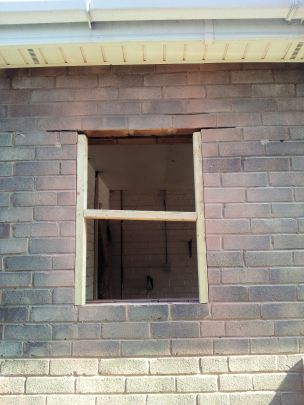
I am beginning to wonder if social services are on ‘Mission Impossible’ trying to deal with dementia.  Members of staff are expected to make an assessment of Maureen’s condition by occasional visits for short periods of time.  They then make decisions about thFeatured imagee amount, and type, of care needed. The photograph of the hole in my neighbour’s garage will help me to illustrate the point I am trying to make.

Our social worker chatted to Maureen for a couple of hours on Wednesday morning.   Maureen seemed in good form and relatively lucid for the duration of her visit.  The social worker concluded that Maureen has capacity to determine her care needs when I plan to be out-of-town visiting family.   She accepted  Maureen’s assertion that she is safe to be left to her own devices for considerable periods of time.

Myself and Maureen’s main carer disagree with the social worker’s opinion.  We have seen how easily Maureen’s presentation fluctuates and confusion, and distress, become dominant in her presentation.  This is where the picture on the right comes in.

A short time after the social worker had gone Maureen became very concerned that next door’s builder would soon be knocking holes in our house .  She went out to talk to him to share her concerns.  Fortunately, he was aware Maureen’s dementia and he handled her concerns sensitively.  His father had  dementia some years ago and he is well versed in the confusion that is prevalent at any time of the day.

The social worker hasn’t got a chance to make an informed judgement by chatting to Maureen on the sofa.  I’m sure she knows that presentation varies but she has never seen Maureen when she is ‘acting out of character’.  The list below gives a few examples of familiar incidents from Maureen in action:

  • Not knowing who familiar faces are: including myself and Chloe.
  • Believing she is living in a Care Home.
  • Thinking her immediate family don’t know where she is.
  • Trying to boil the kettle with the lid off.
  • Being unable to switch on the TV or use the remote control to change channels.
  • Failing to understand how to adjust the central heating.
  • Wandering away from home and leaving external doors wide open.
  • Misplacing keys to external doors.
  • Struggling to find her way home.
  • Stumbling into things, as her eye sight is so poor.
  • Thinking I have gone out when I am in another room.
  • Forgetting that the social worker has visited.
  • Having no recollection of important discussions that have taken place in the previous half hour.

The social worker is being placed in an invidious position and given an impossible task.  Maureen remains a highly intelligent woman who can still ‘talk a good game.’  She is unaware of her ‘out of character behaviour’ and the social worker has never seen her in action.

It also appears that there may be practical, and cultural,  issues within the social workers organisation.  It has not been possible to get through to her dedicated mobile for the last couple of weeks.   Her number has been unavailable.  There have also been several examples of E Mails not being acknowledged, let alone progressed . It is also possible that her workload makes it difficult to keep to deadlines or arrange meetings.

If those with dementia and their Care Partners are to remain safe, and sane, we need to call time on Mission Impossible. On Wednesday next doors builder gained a much clearer idea of how Maureen was than the social worker.  He had two distinct advantages:  he saw Maureen in action and probably more importantly; he had experienced dementia within his own family.  He knows, from bitter experience, it would be risky to rely on chatting on the sofa for a couple of hours before judging whether Maureen is safe to be left to her own devices.

Footnote: Thursday is ‘Trip Day’ by hook or by crook she’s going somewhere today!