Tag Archives: Good Practise

Dementia: What Are We Going To Do Today?

I recall some sound advice I received from a Mental Health Nurse during one of my many periods of depression: ‘Never go to bed without some idea of how you are going to spend the next day.’    Whenever I bump into him I always thank him for this simple piece of advice; because it works.  His advice is crucial to follow as we travel on our journey with dementia.  In my detective role ( as advised by Teepa Snow) I think Maureen’s regular query each night about ; ‘what are you doing tomorrow?’ is possibly more about: ‘what are we going to do tomorrow?’   So I always try to plant some ideas on how we might spend the following day.

As it is Saturday today there are a number of options on the horizon. There is likely to be a Car Boot Sale just across the road, and sometimes we pop across to search for bargains.  With luck I will get that fig plant that I want for my son in law.  I have also mentioned that we could visit the fruit and vegetable market in Grimsby.  We always enjoy wandering around the stalls, as there is a feeling of going back in time in such surrounding: an escape from the impersonal nature of Supermarkets.

At this time of the morning I really have no idea how we will spend our day.  The important thing is I have planted a few ideas that may just come to fruition.  It is bad enough when you are depressed and you can’t think how you are going to spend your day.  Such thoughts even surface when you are retired and have the whole day before you.  I would guess that none of these situations are comparable to having dementia, and not being able to remember how you used to spend you days. However you have to remember all of this is speculative: I am only a budding detective with limited experience of being a Care Partner to someone with dementia.  On the other hand perhaps I am gradually becoming the back up brain (BUB) that my pen friend Kate (Swaffer) has patented in Australia.

Dementia: Becoming A Better Care Partner

As a Care Partner it is easy to look around and point the finger at what others could be doing a little better.  That is simple and anyone can do that all day long.   What is a little more challenging is to look at your performance as a Care Partner and see if you can sharpen up your act.  This is not a Sunday confession session, it is an attempt to list a few things that might just make our journey with dementia a little easier for us both.

The point of departure is an acceptance that Maureen’s dementia is progressing .  Confusion, distress and fear are now predominamt in her presentation.  What follows is a list of things I can do to help us as we travel this road:

  • To attempt to understand Maureen’s reality
  • To attempt to help others to understand Maureen’s reality
  • To listen rather than talk
  • To use simple language and short sentences
  • To stick to one subject at a time
  • To be visible as much as possible
  • To keep the house tidy
  • To have set places for things
  • To pare down Maureen’s clothes even further
  • To attempt to keep Maureen in a positive state of mind
  • To find meaningful activities
  • To socialise in appropriate circles
  • To accept that Maureen’s world is shrinking
  • To try to secure an appropriate Care Package
  • To continue to utilise skills and knowledge within relevant reference groups

I am hoping to blog later in the day on Maureen’s reality.  It depends on how the day progresses.

Dementia: Mission Impossible?

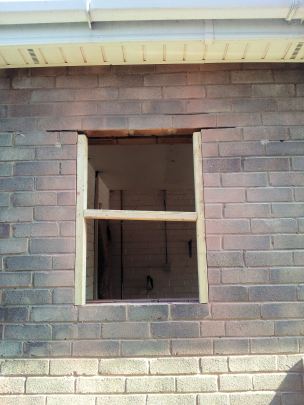
I am beginning to wonder if social services are on ‘Mission Impossible’ trying to deal with dementia.  Members of staff are expected to make an assessment of Maureen’s condition by occasional visits for short periods of time.  They then make decisions about thFeatured imagee amount, and type, of care needed. The photograph of the hole in my neighbour’s garage will help me to illustrate the point I am trying to make.

Our social worker chatted to Maureen for a couple of hours on Wednesday morning.   Maureen seemed in good form and relatively lucid for the duration of her visit.  The social worker concluded that Maureen has capacity to determine her care needs when I plan to be out-of-town visiting family.   She accepted  Maureen’s assertion that she is safe to be left to her own devices for considerable periods of time.

Myself and Maureen’s main carer disagree with the social worker’s opinion.  We have seen how easily Maureen’s presentation fluctuates and confusion, and distress, become dominant in her presentation.  This is where the picture on the right comes in.

A short time after the social worker had gone Maureen became very concerned that next door’s builder would soon be knocking holes in our house .  She went out to talk to him to share her concerns.  Fortunately, he was aware Maureen’s dementia and he handled her concerns sensitively.  His father had  dementia some years ago and he is well versed in the confusion that is prevalent at any time of the day.

The social worker hasn’t got a chance to make an informed judgement by chatting to Maureen on the sofa.  I’m sure she knows that presentation varies but she has never seen Maureen when she is ‘acting out of character’.  The list below gives a few examples of familiar incidents from Maureen in action:

  • Not knowing who familiar faces are: including myself and Chloe.
  • Believing she is living in a Care Home.
  • Thinking her immediate family don’t know where she is.
  • Trying to boil the kettle with the lid off.
  • Being unable to switch on the TV or use the remote control to change channels.
  • Failing to understand how to adjust the central heating.
  • Wandering away from home and leaving external doors wide open.
  • Misplacing keys to external doors.
  • Struggling to find her way home.
  • Stumbling into things, as her eye sight is so poor.
  • Thinking I have gone out when I am in another room.
  • Forgetting that the social worker has visited.
  • Having no recollection of important discussions that have taken place in the previous half hour.

The social worker is being placed in an invidious position and given an impossible task.  Maureen remains a highly intelligent woman who can still ‘talk a good game.’  She is unaware of her ‘out of character behaviour’ and the social worker has never seen her in action.

It also appears that there may be practical, and cultural,  issues within the social workers organisation.  It has not been possible to get through to her dedicated mobile for the last couple of weeks.   Her number has been unavailable.  There have also been several examples of E Mails not being acknowledged, let alone progressed . It is also possible that her workload makes it difficult to keep to deadlines or arrange meetings.

If those with dementia and their Care Partners are to remain safe, and sane, we need to call time on Mission Impossible. On Wednesday next doors builder gained a much clearer idea of how Maureen was than the social worker.  He had two distinct advantages:  he saw Maureen in action and probably more importantly; he had experienced dementia within his own family.  He knows, from bitter experience, it would be risky to rely on chatting on the sofa for a couple of hours before judging whether Maureen is safe to be left to her own devices.

NB: There will be a further blog today sharing a really positive experience.

Dementia: ‘Strictly No Thanks’

Image result for strictly come dancing floor graphics

Maureen and I have always been fond of ballroom dancing.  I often take her in hold at home and we strut our stuff in the kitchen or lounge.  We are a little out of step following Maureen’s stroke and my bilateral hip replacements.  Some years ago we got to Gold Medal standard with Latin and Ballroom.  We are always taking about rejoining a group of friends we used to go dancing with at a local studio.  Whenever we bump into one couple we always say: ‘we’ll be back’.  I genuinely believe it won’t be long until we are back on the floor and I may just have the courage to lead my Dancing Queen.

A couple of days ago when taking to a colleague from the Memory Service dancing came up in our discussion.  I contact Kelly occasionally, as I do a small amount of voluntary work for Dementia Engagement.  She asked me when we would be along to the Tuesday afternoon Dance Session that she has organised?  I had to tell her that she would never see us on the floor at her sessions.  The reason being quite simple: Maureen doesn’t want to go to activities dedicated to those who have ‘memory issues’ – mustn’t use the term ‘dementia’ you see with the Memory Service!

When I mentioned Kelly’s initiative to Maureen she said: ‘You are not taking me along to make an example of me’.   I had suggested that  we might help Kelly out by taking some organisational responsibilty for Tuesday afternoons.  Maureen made it plain that she would sooner stay at home, alone, and let me do my ‘voluntary bit’.  Within minutes I saw her point.

We will go dancing again; perhaps later today.   I’m sure I only have to put the right music on and we’ll be off somewhere in the house.  When we venture out to blow off the cobwebs at a dance studio, or hall, it will be along with familiar faces.  Attending events put on by the Memory Service, or other well meaning organistaions is, not for us.  We both still have the capacity to choose how we want to spend our lives – we don’t need others organising things for us.

By the way the photograph is of Kevin (from Grimsby) and his partner.  His dad Keith taught us the slow foxtrot a few years ago.  I don’t think we would get a ‘Ten from any of Them’.  However, it would be our version of the dance at a venue of our choice!